
Everything You Need to Know About the Occupational Health and Safety Certificate
Occupational health and safety, a subject that grows more important by the day in the interests of company employees' safety and the prevention of accidents at work, has at the same time become a profession in which employment is steadily rising. At a time when more people want to work as an occupational health and safety specialist every year, anyone interested in this profession needs to obtain an occupational health and safety certificate.

Occupational health and safety, a subject that grows more important by the day in the interests of company employees' safety and the prevention of accidents at work, has at the same time become a profession in which employment is steadily rising. At a time when more people want to work as an occupational health and safety specialist every year, anyone interested in this profession needs to obtain an occupational health and safety certificate.
You can read everything you need to know about the occupational health and safety certificate and the institutions that issue it in the rest of our blog post.
What Is the Occupational Health and Safety Certificate and What Is It For?
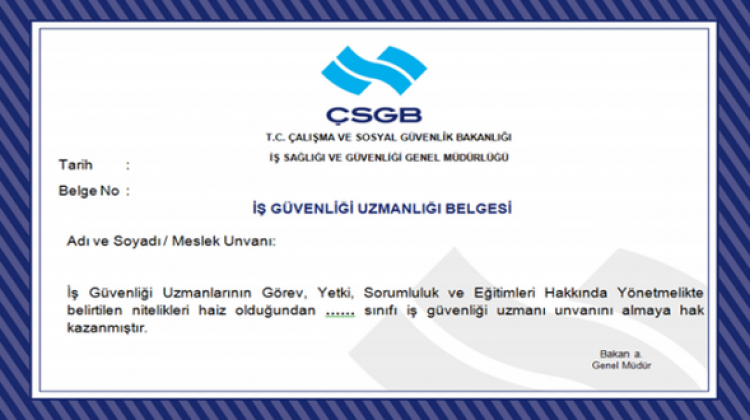
The document that people who want to build a career as an occupational safety specialist must obtain once they have met the necessary requirements is called the occupational health and safety certificate.
Article 6 of Occupational Health and Safety Act no. 6331, published in Official Gazette no. 28339 of 30/06/2012 and headed "Occupational Health and Safety Services", made it mandatory for workplaces to employ an occupational safety specialist, a workplace physician and other health personnel.
With this statutory obligation, the profession of occupational safety specialist has become even more important than it was. For people who want to work in this sector, where employment is steadily rising, obtaining an occupational health and safety certificate is essential. Obtaining this certificate is what allows a person to work as an occupational health specialist.
To look at job opportunities in the field of occupational health and safety, click here .
How Do You Become an Occupational Safety Specialist?
Candidates wishing to become an occupational safety specialist must first attend occupational safety training courses and then sit the Directorate General of Occupational Health and Safety's Workplace Physician and Occupational Safety Specialist Examination. Candidates scoring 70 or above in the examination must obtain an occupational health and safety certificate in order to take up their post officially as an occupational safety specialist. To obtain this certificate, the candidate must prepare the necessary documents and apply.
To see the documents that need to be prepared when applying to obtain an occupational health and safety certificate and become an OHS specialist, click here to read the blog post we have prepared on the subject.
How Do You Obtain the Occupational Health and Safety Certificate?
Candidates wishing to obtain an occupational health and safety certificate must first complete an occupational health and safety programme. This training teaches students, both in theory and in practice, what companies need in the field of occupational health and safety.
Graduates who complete an occupational health and safety programme become entitled to a bachelor's degree. Those graduates can then sit the occupational safety specialist examination held by the Ministry of Labour and Social Security.
Graduates holding a bachelor's degree in occupational health and safety may first sit the class C occupational safety examination. Candidates wishing to sit the class B occupational health and safety examination must hold a class C occupational safety specialist certificate, and candidates wishing to sit the class A examination must hold a class B occupational safety specialist certificate.
The documents required in order to obtain an occupational health and safety certificate are as follows:
- A wet-signed letter of application written in the name of the institution being applied to, containing the candidate's national ID number and contact details
- A diploma evidencing training in the field of occupational health and safety
- To attend the class A programme, a class B certificate and documents proving four years of service while holding it
- To attend the class B programme, a class C certificate and documents proving three years of service while holding it
- A written declaration of the national ID number
What Is the Difference Between Class A, B and C in Occupational Health and Safety?
In occupational health and safety, classes A, B and C indicate the workplace's hazard level from an occupational safety point of view. The classes break down as follows:
- Class A: workplaces regarded as very hazardous
- Class B: workplaces regarded as hazardous
- Class C: workplaces regarded as low-hazard
The Cost of the Occupational Health and Safety Certificate
Once the occupational health and safety paperwork is complete, the practical training given by institutions such as Istanbul Aydın University and ATASEM must be completed in order to obtain the certificate. The subjects covered in the Class C Occupational Health and Safety Training Programme are as follows:
|
SUBJECT NAME |
Occupational Health and Safety |
|
|
Class C |
|
|
Face-to-face Training (Hours) |
|
|
|
|
Opening, Introductions, Programme Overview and Pre-Test |
1 |
|
The Development of Occupational Health and Safety Concepts and Rules |
2 |
|
An Overview of Occupational Health and Safety, and Safety Culture |
2 |
|
Occupational Health and Safety in Turkey and Around the World |
1 |
|
Fundamentals of Law |
– |
|
Labour Law |
3 |
|
Occupational Health and Safety in Legislation |
– |
|
National and International Organisations and Conventions |
1 |
|
Occupational Health and Safety Services |
2 |
|
Occupational Health and Safety Committees |
1 |
|
Occupational Health and Safety Management Systems |
2 |
|
Risk Management and Assessment |
15 |
|
Monitoring the Working Environment |
1 |
|
Occupational Hygiene |
1 |
|
Workplace Buildings and Annexes |
1 |
|
Physical Risk Factors |
4 |
|
Chemical Risk Factors |
4 |
|
Biological Risk Factors |
1 |
|
Psychosocial Risk Factors |
1 |
|
Ergonomics |
2 |
|
Protection Policies |
2 |
|
Occupational Health and Safety in Welding Work |
2 |
|
Occupational Health and Safety in Electrical Work |
3 |
|
Occupational Health and Safety with Lifting Equipment |
3 |
|
Occupational Health and Safety with Motor Vehicles |
1 |
|
Occupational Health and Safety with Hand Tools |
1 |
|
Occupational Health and Safety in Maintenance and Repair Work |
1 |
|
Fire |
5 |
|
Emergency Plans |
2 |
|
Health and Safety Signs |
– |
|
Principles of Ventilation and Air Conditioning |
1 |
|
Occupational Health and Safety in Work with Pressure Vessels |
2 |
|
Occupational Health and Safety in Work in Confined Spaces |
2 |
|
Occupational Health and Safety in Work with Display Screen Equipment |
– |
|
Occupational Health and Safety in Manual Lifting and Handling |
2 |
|
Occupational Health and Safety in Work at Height |
1 |
|
Occupational Health and Safety on Construction Sites |
2 |
|
Occupational Health and Safety at Mining Sites |
2 |
|
Personal Protective Equipment |
2 |
|
Occupational Health and Safety in the Design, Manufacture and Use of Work Equipment |
2 |
|
Accidents at Work |
3 |
|
Health Surveillance and Occupational Diseases |
1 |
|
Checks to Be Carried Out and Records to Be Kept from an Occupational Safety Perspective |
1 |
|
Heavy and Hazardous Work |
– |
|
Special Risk Groups in Working Life |
– |
|
Shift Work and Night Work |
– |
|
Ethics in Working Life |
1 |
|
Adult Education, Health and Safety Training in the Workplace, and Communication |
2 |
|
Assessment and Final Test |
1 |
|
FACE-TO-FACE TRAINING TOTAL: |
90 |
|
Practical Application in the Workplace |
– |
|
OVERALL TOTAL: |
220 |
The occupational health and safety examination fee is around TRY 200 on average. The documents that candidates who pass the examination with a score of 70 or above must prepare in order to obtain the certificate are as follows:
- A petition addressed to the Ministry of Labour and Social Security
- A photocopy of the national identity card
- A certified copy of the diploma or graduation certificate
- The receipt showing that the certificate fee has been paid
To obtain the receipt showing that the certificate fee has been paid, TRY 472 must be paid into the Ministry of Labour and Social Security, Directorate General of Occupational Health and Safety Certificate Collections account through the Corporate Collection Programme at a branch of Ziraat Bankası.
Example of an Anadolu University Occupational Health and Safety E-Certificate
Candidates who attend and successfully graduate from the certificate programmeprepared jointly by Anadolu University and the Ministry of Labour and Social Security may carry out the occupational health and safety role themselves at workplaces with fewer than fifty employees that fall into the low-hazard class. Anyone over the age of 18 may apply to this programme, with no degree requirement.